Field Notes
The Solar Bottleneck in 2026 Isn’t Panels. It’s Operations.
Solar demand is strong in 2026, but tighter margins mean the real bottleneck is now operations, permitting, interconnection, field work, and finance.

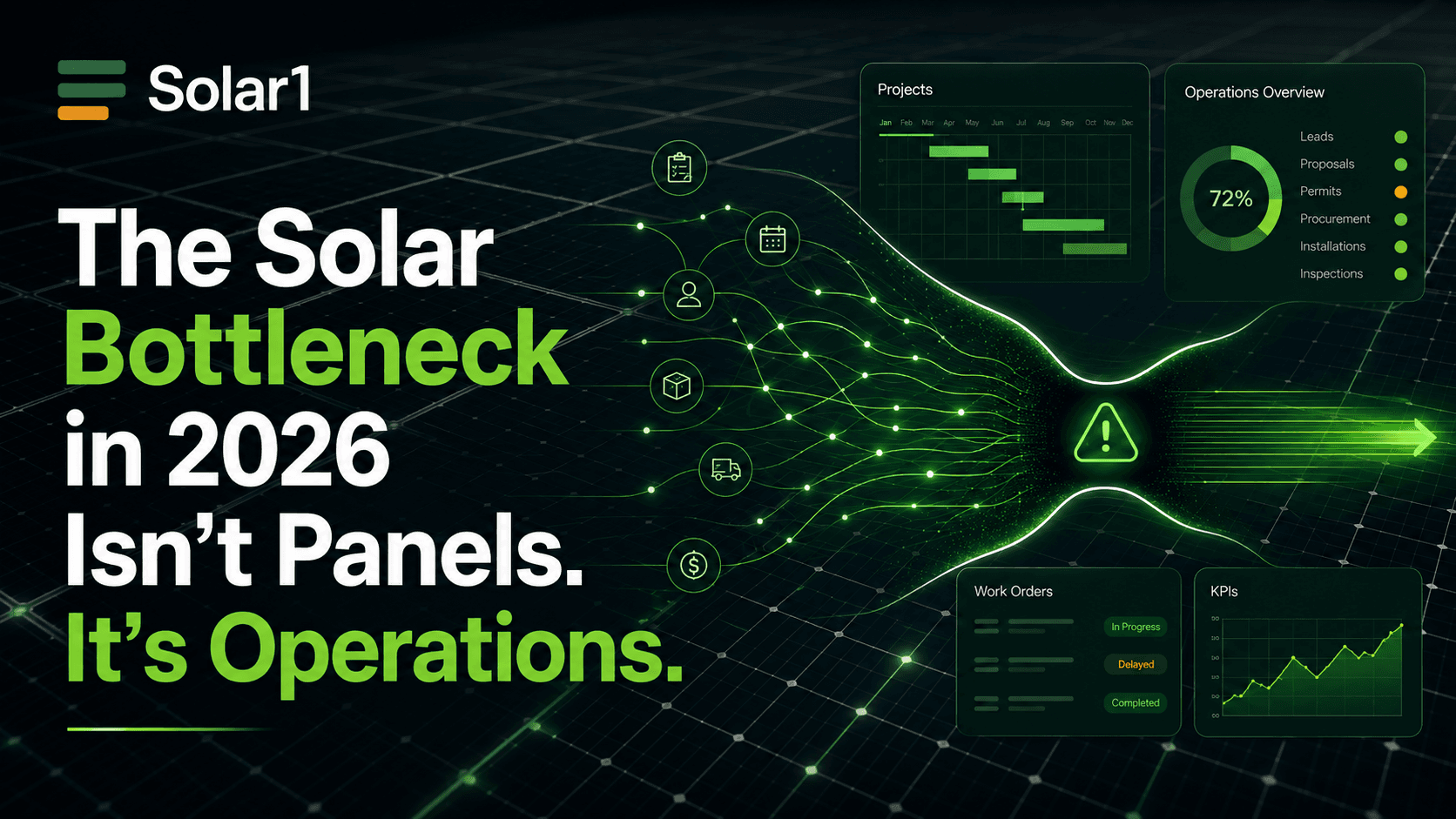
The Solar Bottleneck in 2026 Isn’t Panels. It’s Operations.
For a long time, solar companies worried mostly about hardware: panel prices, inverter availability, battery supply, and installation capacity.
That is still important. But in 2026, the harder problem for many solar installers is not just getting the equipment.
It is getting the job from sold to installed, inspected, interconnected, invoiced, and closed without losing margin along the way.
The U.S. solar market is still large, but it is no longer an easy-growth environment. SEIA reported that the U.S. installed 7.8 GWdc of solar capacity in Q1 2026, down from both Q1 2025 and Q4 2025. Residential solar was up year over year, but still down quarter over quarter. Commercial solar also declined. That means solar companies are operating in a market where demand exists, but execution has become less forgiving.
In simple words: the companies that win now are not only the ones that sell more. They are the ones that control the work after the sale.
The real cost is hiding between departments
Most solar companies do not lose money in one dramatic moment.
They lose it in small gaps:
A sales rep promises a timeline that operations cannot meet.
A permit requirement changes and nobody updates the team.
A utility document sits in someone’s inbox for three days.
A field crew arrives without the latest plan set.
An inspection fails, but finance still thinks the project is ready to invoice.
A project manager spends half the morning asking people for updates instead of moving jobs forward.
None of this looks like a big software problem at first. It looks like normal daily chaos.
But when it happens across 20, 50, or 200 active projects, it becomes a margin problem.
The Department of Energy defines solar soft costs as the non-hardware costs around going solar, including permitting, financing, installation, interconnection, customer acquisition, supplier costs, and company overhead. In other words, the cost problem is not only on the roof. A lot of it is in the workflow.
Why 2026 is forcing installers to clean up operations
Solar is becoming more complex, not less.
Customers expect faster timelines. Utilities still have their own process. AHJs have different rules. Storage is becoming part of more projects. Financing models are changing. Residential, commercial, and community solar companies are all under pressure to protect margins.
At the same time, energy storage is growing fast. Reuters reported that U.S. energy storage additions hit a first-quarter record in Q1 2026, driven by demand from data centers, electricity price uncertainty, and broader grid needs.
That matters because solar-plus-storage projects usually create more coordination work: more equipment, more documentation, more technical review, more field details, and more handoffs.
This is where many solar companies start feeling the pain. They may have a CRM for sales, spreadsheets for operations, WhatsApp for field updates, accounting software for invoices, and emails for permits.
Each tool works on its own. But the company does not work as one system.
A CRM is not enough anymore
A CRM can tell you who the customer is, what stage the deal is in, and what the sales team promised.
That is useful.
But after the contract is signed, a solar company needs more than sales tracking.
It needs to know:
Which AHJ is responsible for the permit?
What documents are missing?
Has the utility application been submitted?
Is the design approved?
Is the crew scheduled?
Did the inspection pass?
Can finance raise the invoice?
Is the customer waiting for PTO?
What is blocking the job today?
That is not only CRM work. That is operations, project management, field service, permitting, inventory, and finance working together.
This is where ERP becomes important for solar companies.
What a solar ERP should actually do
A solar ERP should not be just another dashboard that looks clean during a demo.
It should reduce the number of places your team has to check before they can answer a simple question: “What is happening with this job?”
A practical solar ERP should connect the full project lifecycle:
Lead captured → site survey → design → proposal → contract → permit → procurement → installation → inspection → interconnection → PTO → invoice → service.
The value is not just in storing data. The value is in making handoffs clear.
For example, when a permit is approved, the installation team should know. When inspection fails, the project manager should know. When PTO is received, finance should know. When a field note is added, it should not disappear inside a WhatsApp chat.
The best solar operations systems make the next step obvious.
Permitting and interconnection need their own workflow
Permitting is one of the biggest places where solar companies lose time.
SolarAPP+ exists because manual permit review has been a real bottleneck for residential solar. The platform is designed to automate compliant plan review for eligible residential solar and storage permits. SolarAPP+ says it has served 350+ jurisdictions, issued 150K+ permits, and saved 150K+ staff hours.
But even with automation improving parts of the market, not every project is instantly approved. Not every jurisdiction uses the same process. Not every installer works in only one AHJ.
So the internal workflow still matters.
Your team needs a clean way to track:
AHJ requirements
Permit status
Missing documents
Review comments
Resubmissions
Inspection schedules
Utility application status
PTO status
Customer communication
Finance unlock points
Without this, project managers become human routers. They spend their day chasing updates instead of managing projects.
The field team should not be disconnected from the office
A solar ERP also needs to work for the people on the ground.
This is where many systems fail.
The office team may have a clean project board, but the installer in the field is still sending photos on WhatsApp. The project manager is downloading images manually. The designer does not know which roof condition changed. The finance team does not know whether the job is actually complete.
Mobile access is not a “nice extra” anymore.
For solar companies, mobile access means field crews can update job status, upload photos, add notes, flag issues, check task lists, and keep the office informed without waiting until the end of the day.
That is how you reduce rework.
That is how you avoid missed details.
That is how the company stops depending on memory.
Finance should not wait until the end
In many solar companies, finance is treated like the final step.
But finance is affected by every delay before it.
If the permit is delayed, cash collection is delayed. If inspection fails, invoicing is delayed. If PTO is not tracked properly, final payment may be delayed. If change orders are not captured, margin disappears.
A solar ERP should make finance part of the project flow.
That means payment milestones, approved change orders, purchase costs, install completion, inspection status, and invoice readiness should be visible in the same system.
This is especially important when margins are tighter. A company can sell a lot of jobs and still feel cash pressure if operations and finance are not connected.
The companies that scale will run on one source of truth
A small solar company can survive with spreadsheets for some time.
But as the project count grows, spreadsheets become harder to trust.
The problem is not that spreadsheets are bad. The problem is that they do not naturally manage handoffs, approvals, reminders, permissions, field updates, documents, finance triggers, and accountability across departments.
That is why the next stage of solar operations will be about connected systems.
Not because software is trendy.
Because the business needs one source of truth.
Sales should see what operations can actually deliver.
Operations should see what is blocking each job.
Field teams should see the latest scope.
Finance should see what is ready to bill.
Owners should see margin, pipeline, delays, and capacity without asking five people.
Solar1’s view
At Solar1, we believe solar companies do not need more scattered tools.
They need one operating system built around how solar work actually moves.
That means CRM, project tracking, permitting, interconnection, field updates, documents, finance, and reporting should not live in separate islands.
The goal is simple: help solar teams move more projects with less chaos.
Because in 2026, the real advantage is not only selling solar.
It is delivering solar cleanly, profitably, and repeatedly.